
Why Are Green Card Holders Being Detained? Green card holders — lawful permanent residents with the legal right to live and work in the United States — have increasingly faced detention and deportation amid intensified immigration enforcement.
Authorities have targeted individuals with prior criminal records, even for minor or decades-old offenses, arguing that certain convictions make residents deportable under immigration law.
Some detentions have occurred at ports of entry, airports, and even routine check-ins with immigration officials.
Critics, including legal experts and civil rights organizations, warn that these actions violate due process rights and create a climate of fear among millions of legal residents who considered themselves secure.
Table of Contents
Quick Table
| Reason | Details |
|---|---|
| Criminal Record | Even minor or old convictions can trigger deportation proceedings under immigration law |
| National Security Concerns | Suspected ties to foreign threats or flagged travel history |
| Immigration Violations | Overstaying before receiving a green card or past visa fraud |
| Missed Check-ins | Failing to report address changes or skipping scheduled ICE appointments |
| Social Media Activity | Posts flagged as supporting foreign terrorist organizations or extremist views |
| Entry at Ports / Airports | Detained upon returning from international travel for additional screening |
| Public Charge Ground | Receiving certain government benefits may raise deportability concerns |
| Procedural Errors | Paperwork mistakes or misrepresentation during the green card application process |
| Executive Policy Shifts | Broader enforcement priorities under current administration targeting legal residents |
| Association Concerns | Known associations with individuals or groups under federal investigation |
Why Are Green Card Holders Being Detained?
My neighbor Maria has lived in the United States for 23 years. She raised three kids here, owns a home, pays taxes, and votes in local elections — oh wait, no, she can’t vote.
She’s a green card holder. A lawful permanent resident. She did everything “right.”
Last year, when her sister got sick back in the Philippines, she flew home to help.
On her way back into the U.S., she was pulled into secondary inspection at the airport. She sat in a holding room for six hours.
Officers searched her phone. They asked questions about her social media posts.
She got through. But for those six hours, she genuinely didn’t know if she was going home to her kids or being put on a plane to a country she hadn’t lived in for over two decades.
And Maria isn’t the only one.
What’s happening to green card holders across the United States right now is something a lot of people don’t fully understand — including, honestly, many of the green card holders themselves
First, Let’s Clear Up a Common Misconception
A lot of people assume that having a green card means you’re basically treated like a citizen for immigration purposes. That the hard part is over. That you’re safe.
That assumption is wrong — and right now, it’s a dangerous assumption to hold.
A green card (formally called Lawful Permanent Resident status, or LPR) gives you the right to live and work permanently in the U.S. But it doesn’t make you untouchable.
The government can still detain and deport you under specific legal circumstances. And in 2025, the definition of those “specific circumstances” got a lot wider, a lot faster, than most people expected.
What’s Actually Going On
Starting in early 2025, the Trump administration launched an aggressive expansion of immigration enforcement.
And while most of the early headlines focused on undocumented immigrants, what happened next caught a lot of people off guard.
Green card holders — people with full legal status — started getting detained at rates that immigration attorneys described as unlike anything they’d seen in recent memory.
At airports. At USCIS offices. During routine check-ins. In their own communities.
The American Immigration Council reported that the number of people held in ICE detention rose nearly 75% in 2025 alone — from around 40,000 at the start of the year to 66,000 by December — the highest level ever recorded in U.S. history.
And the demographics of who was getting detained shifted dramatically. This wasn’t just about undocumented people anymore.
The Reasons Green Card Holders Are Being Detained
Here’s where it gets complicated — because there isn’t just one reason. There are several, and they’re affecting different people in different ways.
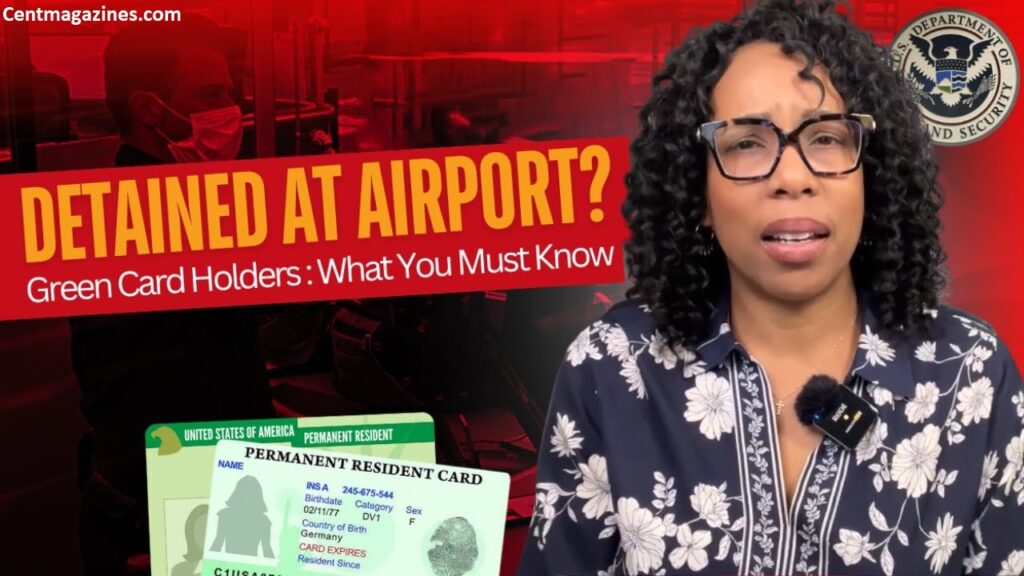
Old Criminal Convictions That Were Never an Issue Before
This is the big one. And it’s blindsiding people.
Under immigration law, certain criminal convictions can make someone deportable — even if they’re a green card holder, even if the conviction is decades old, even if they already served their time.
What’s changed isn’t the law itself. What’s changed is the enforcement priority.
Convictions that immigration officials previously overlooked or deprioritized are now being actively used as grounds for detention.
NPR covered the case of Lewelyn Dixon, a 64-year-old Filipina woman who had lived near Seattle for decades. She was detained for nearly three months after returning from a trip to the Philippines.
The reason? A workplace theft conviction from 2001 — over 20 years ago — for which she had already served her time.
She had traveled internationally multiple times since then without any issue. An immigration judge ultimately allowed her to stay, but she spent months in detention first.
Cases like hers are happening across the country.
Traveling Outside the U.S. and Coming Back
Re-entry is now one of the riskiest moments for green card holders. Customs and Border Protection (CBP) has significantly increased scrutiny at airports and border crossings.
Officers now routinely ask about political beliefs, social media activity, associations, and criminal history — even for minor or dismissed charges.
Devices including phones and laptops are being searched. In some cases, green card holders returning from completely routine international trips are being pulled aside for hours or flagged as “arriving aliens” — a legal classification that strips away several protections.
There’s a key distinction in immigration law between a green card holder classified as a “returning resident” and one classified as an “arriving alien.
” If CBP considers you the latter — which can happen if you’ve been outside the U.S. for more than 180 days, or if you’ve had certain legal issues — you lose key protections and can be detained while your case is reviewed.
One German electrical engineer, Fabian Schmidt, who had held a green card since 2008, was arrested at Boston Logan International Airport.
He reportedly had a decade-old misdemeanor marijuana charge in California that had been dismissed — but it was enough to flag him under the new enforcement posture.
Political Activity and Social Media Posts
This is the one that alarms civil liberties groups the most.
The National Immigration Law Center (NILC) issued a formal community alert warning that the current administration is targeting green card holders not just for criminal records but also for political activity — including posts on social media.
The case that brought this to national attention was Mahmoud Khalil, a Columbia University graduate and green card holder, who was arrested at his university apartment in New York City.
He had no criminal convictions. He was arrested because of his role organizing pro-Palestinian protests on campus. The administration labeled him a national security threat.
He was transferred to a detention facility in Louisiana — over 1,000 miles from his home and his pregnant wife, a U.S. citizen.
His case became a flashpoint for the question of whether green card holders have First Amendment protections.
Legally, noncitizens do have speech protections — but the administration is using a different legal pathway, citing national security provisions in immigration law that are notoriously broad.
And it’s not just protests. The administration has explicitly stated it’s monitoring social media accounts.
DHS and the State Department have been scrutinizing social media posts on platforms like Facebook, Instagram, X (Twitter), TikTok, and even WhatsApp and Telegram.
A new rule even proposed requiring green card applicants to hand over five years’ worth of social media handles.
If you’ve posted anything that could be characterized as politically controversial — particularly related to foreign policy — that could now be a factor in your immigration status.
Pending or Stalled Green Card Applications
Here’s another layer that doesn’t get enough attention.
In December 2025, USCIS suspended all green card processing for nationals of 19 countries, later expanding that to 40 countries in January 2026.
For people whose applications were in process, this created a legal limbo. Their temporary status expired, but their green card hadn’t been issued yet.
ICE used that gap. People who had entered the U.S. legally, with pending approved applications, were being arrested because their interim status had technically lapsed — even though they were eligible for green cards and would have received them if the processing hadn’t been frozen.
This is arguably the most legally murky category, and immigration attorneys across the country are fighting these cases in court.

What Happens When a Green Card Holder Is Detained
- If you or someone you know is detained, here’s what the process actually looks like — and what rights still exist.
- You have the right to a hearing before an immigration judge. The government cannot simply deport a green card holder on the spot. They must prove you are removable. You have the right to present evidence, call witnesses, and challenge the case against you. Do not waive this right. No matter what an officer tells you, do not sign anything that says you’re giving up your right to a hearing.
- You are not entitled to a court-appointed lawyer — immigration proceedings are civil, not criminal. But you have the right to hire one. This matters enormously. Statistically, having an immigration attorney dramatically improves outcomes.
- You may be eligible for bond. ICE is required to inform detained individuals within 48 hours whether they qualify for bond. If bond is denied or set unaffordably high, you can request a bond hearing before an immigration judge.
- You have the right to contact your consulate. The consulate of your home country can sometimes provide assistance, advocacy, and connections to legal resources.
- Do not sign Form I-407. If CBP or ICE presents you with Form I-407 — the “Abandonment of Lawful Permanent Resident Status” form — do not sign it. Signing voluntarily surrenders your green card status. If you refuse to sign, the government is forced to go through proper legal proceedings to remove you, and an immigration judge must make that call — not a border officer.
What Green Card Holders Should Do Right Now
Whether you feel at risk or not, here are practical steps that immigration lawyers are strongly recommending:
- Get a legal assessment. If you have any criminal history — even a dismissed charge, even something from 20 years ago — consult an immigration attorney now. Not after you get detained. Not at the airport. Now. Understanding your specific exposure before anything happens is the single most valuable thing you can do.
- Know your rights at the border. You have the right to remain silent. You have the right to refuse to answer questions about your political beliefs, protest activity, or First Amendment-protected speech. You have the right to an interpreter. Write the contact information for your attorney on a piece of paper and carry it separately from your phone — because your phone may be searched.
- Think carefully about travel. Especially if you have any criminal history, any politically sensitive social media posts, or any pending immigration filings. For some people, international travel right now carries real risk. Talk to an attorney before you book that flight.
- Create a family emergency plan. This sounds extreme. It isn’t. Designate a trusted person who has copies of your immigration documents. Make sure your family knows what to do if you’re detained — who to call, where your documents are, what your attorney’s number is. If you have children, consider establishing a temporary guardianship document just in case.
- Be thoughtful about social media. This is a genuinely difficult one, because it runs up against free speech values. But the reality is that the government is actively monitoring social media accounts of green card holders, and posts that could be characterized as politically controversial — particularly around foreign policy — are being used against people. That’s the environment right now.
- Carry your green card at all times. Having documentation of your lawful status can help resolve encounters more quickly, though it doesn’t guarantee you won’t be detained.
The Bigger Picture
What’s happening right now represents a genuine shift in who immigration enforcement targets — and in what legal basis it operates on.
For decades, having a green card meant a certain kind of stability. You might not be a citizen, but you were effectively settled. You built your life, raised your family, paid into Social Security.
The idea that an old minor conviction, a social media post, or a trip abroad could upend all of that felt theoretical.
It’s not theoretical anymore.
The people being detained aren’t nameless statistics.
They’re parents, spouses, neighbors, coworkers. People who followed the rules, went through years of paperwork, and were told — implicitly — that they were permanent.
The law hasn’t fundamentally changed. But enforcement priorities, interpretations, and the political will to pursue cases against long-term legal residents have shifted significantly.
And that gap between what people believed their green card status meant and what it actually guarantees in practice? That gap has never been more painfully visible.
If you’re a green card holder, or you have family members who are — the time to understand your rights, your risks, and your options is before you need that information urgently.
Don’t wait for a six-hour interrogation at an airport to find out what your protections actually are.
FAQ’s
Can a green card holder be detained without warning?
Yes. Immigration authorities can detain lawful permanent residents at ports of entry, airports, ICE check-ins, or even at home, often without prior notice, particularly if a deportable offense or security concern has been flagged in their record.
What rights do green card holders have if detained?
Green card holders have the right to an immigration hearing before a judge, the right to hire an attorney at their own expense, and the right to contact their country’s consulate. However, they do not have the same constitutional protections as citizens in all circumstances.
Can a green card holder be deported for an old criminal conviction?
Yes. Under current immigration law, certain criminal convictions — even minor or decades-old offenses — can make a permanent resident deportable, especially aggravated felonies, drug offenses, and crimes involving moral turpitude.
Does detention mean automatic deportation?
No. Detention initiates removal proceedings, but a green card holder can fight their case in immigration court. An experienced immigration attorney can challenge the grounds for deportation and potentially have the case dismissed.
How has recent policy changed enforcement against green card holders?
Recent administrations have significantly broadened enforcement priorities, lowering the threshold for what triggers detention and deportation, leading to a sharp increase in cases involving lawful permanent residents who previously felt their status was secure.
Conclusion
The detention of green card holders represents one of the most alarming and contested developments in recent American immigration enforcement.
For decades, lawful permanent residents operated under a reasonable assumption of security — that their green card was a stable foundation, not a fragile privilege subject to sudden revocation.
That assumption has been fundamentally shaken.
Sweeping policy shifts, aggressive enforcement priorities, and expanded interpretations of deportable offenses have left millions of legal residents vulnerable in ways they never anticipated.
Many of those detained have lived in the United States for years, even decades, raising families, paying taxes, and contributing deeply to their communities.
The legal and human consequences are profound. Families are separated, livelihoods are destroyed, and entire communities are gripped by fear and uncertainty.
Civil rights advocates, immigration attorneys, and constitutional scholars continue to raise urgent alarms about due process violations and the erosion of legal protections that once seemed ironclad.
While governments have the authority to enforce immigration law, the manner and scope of current enforcement has sparked a vital national conversation about fairness, justice, and what it truly means to belong in America.
For green card holders, that conversation could not be more personal — or more urgent.